
Best Red Hair Colors for Women Over 40 (Flattering, Not Bold)
September 30, 2026 • Color
You've been thinking about red for a while now. Maybe you're tired of the same brunette you've worn for a decade, or you tried red once in your twenties and it went orange within two weeks. Whatever brought you here, there's a hesitation underneath it. Red feels like a big swing. You picture something too bright, too harsh, too "look at me" for where you are in life right now. That hesitation is fair, but it's based on the wrong version of red.
After 30+ years behind the chair, I can tell you that red is one of the most flattering color families for women over 40, when it's done right. The problem isn't the color itself. It's that most red hair color you've seen is either a costume-store orange or a flat, one-dimensional box-dye red that fades fast and looks nothing like what grows out of anyone's head naturally. The reds that actually work for this stage of life are softer, warmer, and built to complement your skin instead of competing with it.
Why Red Intimidates Women Over 40 (And Why It Shouldn't)
A lot of my clients come in saying some version of "I love red but I don't think I could pull it off." Usually what they're picturing is a saturated, fire-engine red that reads more like a statement than a hair color. That version of red absolutely can look harsh against mature skin, especially if your complexion has cooled or your undertones have shifted with age, which happens to most of us.
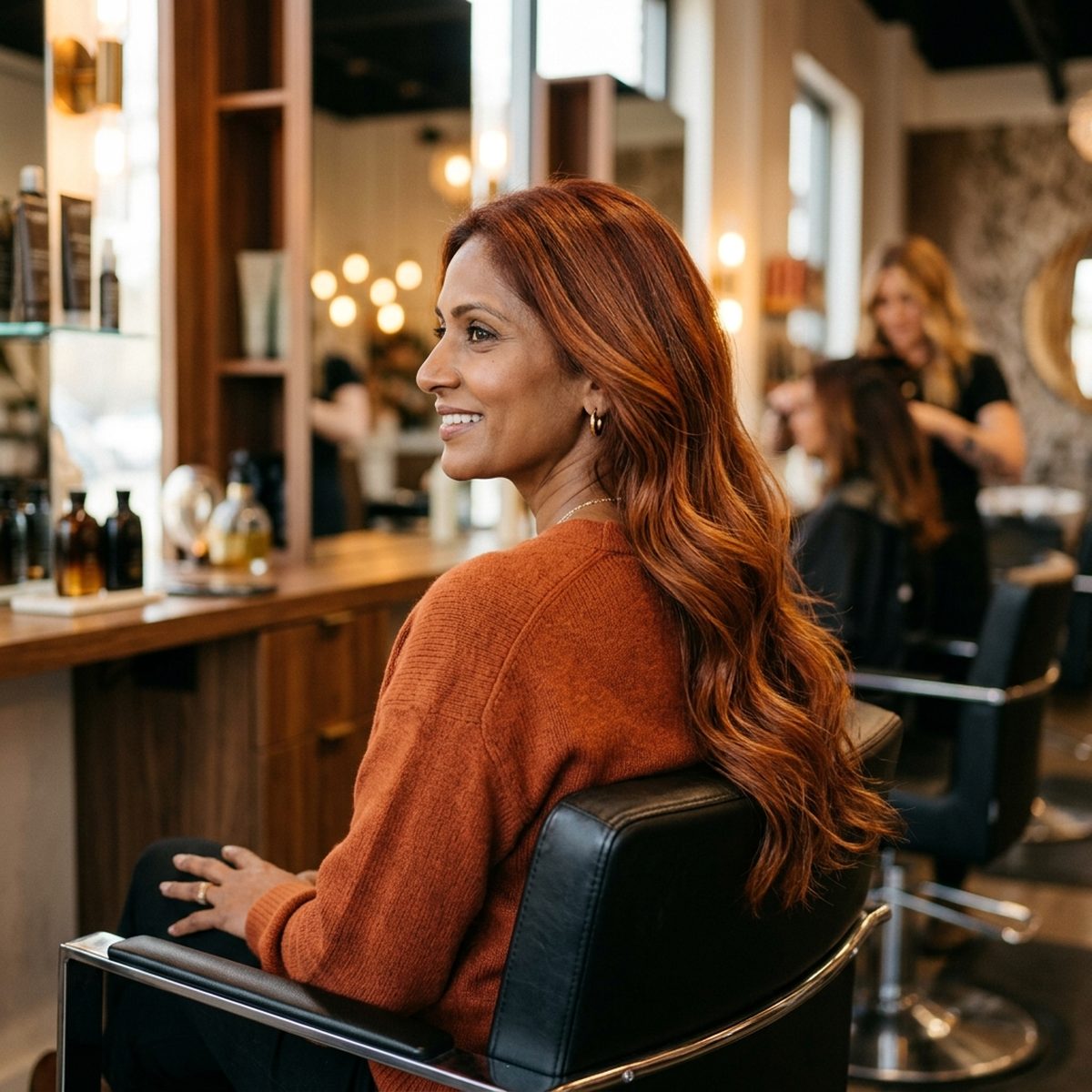
But there's a whole spectrum of red that isn't about being bold. It's about warmth. A well-matched auburn or copper does for your face what a good highlighter does for your makeup: it brings light and warmth back to areas that might be looking a little tired or flat. That's the opposite of harsh. It's genuinely one of the most youthful-looking color choices I put on clients in your age range, and it photographs beautifully in every kind of light.
The Reds That Actually Flatter Women Over 40
Soft Copper
Copper is warm without being loud. Think of it as red with gold woven through it rather than red on its own. This is usually my starting point for a client transitioning from brunette who wants warmth and dimension without a dramatic change. It's especially flattering on lighter to medium skin tones with warm or neutral undertones, and it catches the light in a way that solid brunette just doesn't.
Rich Auburn
Auburn sits between red and brown, and it's probably the most versatile shade in this whole category. It reads as sophisticated rather than trendy, which is exactly why it holds up so well over time. I love auburn for clients who want to look like they were simply always meant to be this color, not like they just got a dramatic makeover. It works beautifully across a wide range of skin tones, from fair to deeper medium complexions, because the depth of the brown base keeps it grounded.
Mahogany
Mahogany brings in a hint of cool plum underneath the red, which makes it a great option if copper or auburn feel slightly too warm against your complexion. It has real depth and richness to it, almost like a fine wine, and it tends to look especially luxurious on darker brunette bases. If you have cooler undertones in your skin, this is usually the shade I steer you toward.
Soft Red Balayage
If full commitment to red feels like too much right now, balayage lets us introduce red gradually. Hand-painted copper or auburn pieces woven through your existing base give you the warmth and dimension of red without an all-over color change, and it grows out beautifully since there's no hard line to maintain.
The 3-Step Process I Use to Find Your Red
Step 1: A Real Skin Tone Consultation
Before we talk about any specific shade, I look at your skin's undertone, your eye color, and the natural depth of your current hair. Red is one of the least forgiving colors when it's mismatched to your undertone, and one of the most flattering when it's matched correctly. This step isn't optional. It's the difference between red that looks like it belongs on you and red that looks like a wig.
Step 2: A Formula Built for Longevity, Not Just Day One
Red fades faster than almost any other color family because the red pigment molecule is larger and washes out with every shampoo. I build your formula knowing this in advance, layering in tones that fade gracefully into a warm, still-flattering color instead of a dull, brassy one. I'll also talk you through the color-safe products that actually extend your red, since drugstore shampoo will undo this work in a matter of weeks.
Step 3: A Maintenance Plan That Fits Your Life
We'll talk honestly about how often you're realistically willing to come in. Some reds need a refresh every four to six weeks to stay vibrant. Others, especially the balayage approach, can stretch to eight or ten weeks. I'd rather build you a red that fits your actual schedule than one that looks perfect for two weeks and disappointing for the other six.
Caring for Red Hair Between Appointments
Red is the highest-maintenance color family, and I'd rather tell you that upfront than have you find out after your first wash. The pigment molecules in red dye are physically larger than they are in blonde or brunette formulas, which means they sit closer to the surface of the hair shaft and rinse out faster with every shampoo. A few habits make a real difference between appointments. Wash with cool or lukewarm water instead of hot, since heat opens the hair cuticle and lets color escape faster. Space out your washes where you can, and use a color-safe, sulfate-free shampoo built for red specifically, since a lot of purple shampoo formulas designed for blondes will actually pull warmth out of red instead of protecting it. I'll send you home with specific product recommendations after your appointment based on exactly which red we land on, since copper, auburn, and mahogany each fade in slightly different directions and need slightly different upkeep.
Heat styling matters too. Red fades faster with frequent hot tool use, so a heat protectant isn't optional if you're blow drying or straightening regularly. None of this means red is high-effort in a bad way. It just means it rewards a little intention, the same way any investment in your hair does.
What Happens If You Get the Wrong Red
I've corrected more bad reds than almost any other color mistake, and it's almost always the same story. Someone went too bright, too cool, or too warm for their undertone, and within a few weeks it faded into something orange, pink, or muddy instead of the rich color they wanted. Box dye is the most common culprit here since it can't be adjusted for your individual undertone the way a professional formula can. If this has already happened to you, it's fixable, but it usually requires proper color correction rather than another round of the same red on top.
What Success Looks Like
Clients who get their red right tend to say the same thing: people keep asking if they did something different, even though all they did was change their hair color. That's the sign of a well-matched red. It doesn't scream for attention. It just makes you look warmer, more rested, and more like the best version of yourself. Several of my clients who were nervous about "going red" have told me it ended up being the most complimented color change they've ever made, precisely because it felt like an enhancement instead of a transformation.
Red isn't as bold a move as it feels like from the outside. Done well, it's one of the most flattering, natural-looking choices available to you. If you've been curious about red hair color for women over 40, let's find your undertone match together. Browse our hair color services, or if you're still deciding between a subtle shift and a bigger change, read our guide on the best hair color for women over 50 for more on how we approach color at this stage of life. Ready to see your own version of red? Book a consultation at Moxi Hair Studio in McKinney, TX.
Follow: @moxihairstudiodfw