
How to Care for Your Hair Extensions at Home (To Make Them Last)
September 4, 2026 • Extensions
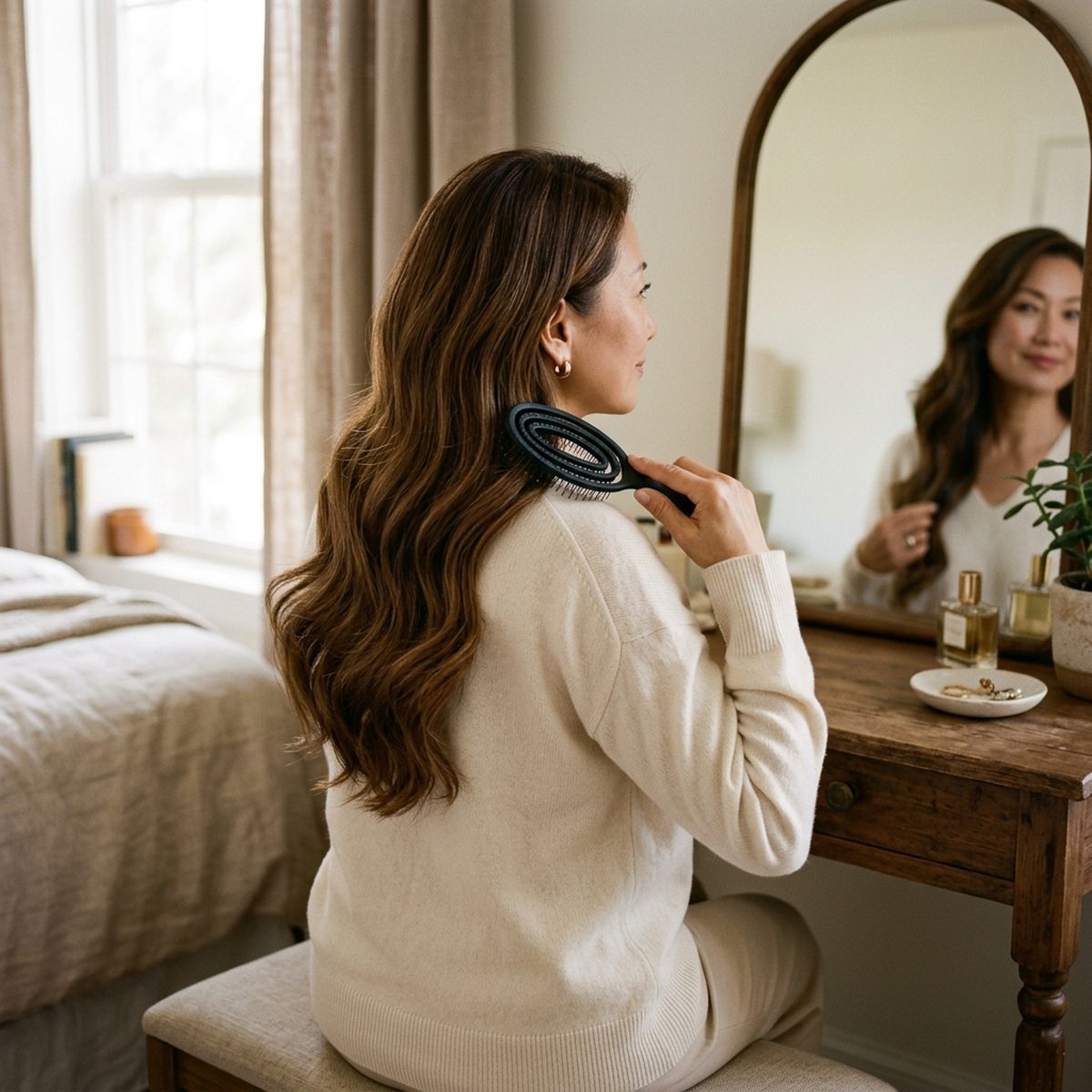
You just walked out of the studio with the fullest, longest hair you've had in years, and you cannot stop touching it. I love that moment with every extension client I have. But here's the conversation that matters just as much as installation day, and it's the one that gets skipped the most. What you do at home over the next 6 to 8 weeks is what decides whether your extensions still look this good at your next appointment, or whether they're matted, tangled, and shedding before their time.
Extensions are a real investment, both financially and in the time it takes to get the color and placement right. I've spent more than 30 years behind the chair, and I can tell you the difference between a client whose extensions look incredible at 8 weeks and one whose extensions look rough almost never comes down to the hair itself. It comes down to the daily habits nobody explained clearly enough the first time.
So let's fix that. Here is exactly how to care for your extensions at home, the same way I walk every client through it at Moxi Hair Studio.
Why Extension Aftercare Is Different From Regular Hair Care
Your natural hair has its own oils, its own root support, and it can tolerate a certain amount of rough handling without much consequence. Extensions don't have that same forgiveness. Whether you have hand-tied wefts, tape-ins, or keratin bonds, the attachment point is doing real work every day, holding weight, moving with you, getting brushed and washed and slept on.
Treat that attachment point gently and your extensions reward you with months of great hair. Treat it carelessly and you'll see tangling, slippage, and breakage far sooner than you should. The good news is that the habits that protect your extensions are simple. They just have to become routine.
The 3-Step Daily Care Routine
Step 1: Brush the Right Way, More Than Once a Day
This is the single biggest thing I teach every extension client, and it's the one habit that prevents the most problems. You need a loop brush or a extension-specific brush with soft, flexible bristles, not a regular paddle brush and definitely not a fine-tooth comb.
Brush at least twice a day, once in the morning and once before bed. Start at the ends and work your way up in small sections, holding just above the attachment point with your other hand so you're not putting tension directly on the bond or weft while you brush through tangles. Skipping this step, even for a day or two, is how small tangles at the root turn into a matted mess that takes an emergency appointment to fix.
Step 2: Wash Less Often, and Wash Gently
I know this feels backwards if you're used to washing daily, but extensions actually do better with less frequent washing, typically 2 to 3 times a week. Overwashing strips the natural hair's oils and can loosen tape-in adhesive faster than it should.
When you do wash, use a sulfate-free, extension-safe shampoo and apply it to your scalp, letting the suds rinse down through the lengths rather than scrubbing shampoo directly into the extensions. Always wash with your head tipped back, never bent forward over the tub, since bending forward lets the hair tangle around itself at the base. Condition from mid-length to ends only, keeping conditioner away from the attachment points, and rinse thoroughly. Pat dry with a microfiber towel instead of rubbing, since rubbing wet hair is one of the fastest ways to create tangles and frizz at the root.
Step 3: Protect Them Overnight and Through Styling
What happens while you sleep matters more than most people realize. Never go to bed with wet extensions, since wet hair tangles and mats far more easily overnight. Before bed, brush through completely and either braid your hair loosely or pull it into a low, soft ponytail or a silk or satin sleep cap. A silk pillowcase helps too, since it creates less friction against the hair than cotton.
For styling, heat tools are generally safe on quality extensions, but keep the heat away from the actual bond, tape, or weft attachment, and always use a heat protectant first. Skip products with heavy oils or silicones near the root, since buildup there attracts tangling and can affect how securely the extensions sit. A lightweight leave-in conditioner on the mid-lengths and ends is usually all you need day to day.
What to Avoid Completely
A few habits cause more damage than anything else I see, so I want to call them out directly.
- Sleeping with wet hair. This is the number one cause of matting at the root.
- Using a regular brush instead of a loop brush. Standard brushes pull and snag at the attachment points.
- Swimming without protection. Chlorine and salt water are hard on extension hair. Braid it and rinse with fresh water before and after if you're headed to the pool or lake.
- Skipping your move-up appointment. Even with perfect home care, extensions need to be moved up roughly every 6 to 8 weeks as your natural hair grows out from underneath them. Waiting too long puts uneven weight on your natural hair and shortens the life of the extensions themselves.
- Using products meant for your natural hair only. Extension hair doesn't produce its own oils the way your scalp does, so it needs different, gentler products designed to keep it hydrated without weighing it down.
How Long Should Well-Cared-For Extensions Last?
With the routine above and regular move-up appointments, most of my clients get 6 to 12 months or longer out of the same set of hair, depending on the method. That's a meaningful return on an investment that can run well over a thousand dollars, which is exactly why I spend real time on this conversation at your installation appointment and not just a quick rundown on your way out the door.
If you're still deciding whether extensions are right for you in the first place, my post on how extensions add volume and thickness walks through who makes a great candidate and what the installation process actually looks like.
When Something Feels Off, Don't Wait
If you notice unusual tangling at the root, a bond that feels loose, or discomfort that doesn't go away after a day, don't try to fix it yourself at home. Reach out and let me take a look. Catching a small issue early is always easier than repairing damage that's had weeks to build. And if you're ever unsure whether your natural hair is holding up well underneath your extensions, that's exactly what your move-up appointments are for. I check the health of your hair and scalp every single time.
If frizz or humidity is part of what's making your extensions harder to manage day to day, you might also find my smoothing treatments helpful between installations to keep everything sleek and easier to style.
Ready for Extensions That Actually Last?
Good extensions start with expert installation, but they're kept beautiful by what you do at home every single day. If you're considering extensions for the first time, or if you've had a rough experience elsewhere and want a fresh start with a real aftercare plan, I'd love to talk with you. Explore my hair extension services and book a complimentary consultation. I'll walk you through everything, from the right method for your hair to the exact home care routine that will keep your investment looking its best for months to come.
Moxi Hair Studio is located at 6700 Alma Rd, Suite 101, in McKinney, TX. I serve clients from McKinney, Allen, Frisco, Plano, Prosper, and throughout Collin County. Book your consultation today.
Follow: @moxihairstudiodfw